Holding the right institution accountable is the first step toward fixing Nigerian football.
The disappointment echoing across the country is both real and understandable.
Millions of Nigerians remain deeply pained by the Super Eagles’ failure to qualify for the FIFA World Cup and the Super Falcons’ inability to successfully defend their WAFCON title.
Emotions are running high, and many fans have directed their fury squarely at the Nigeria Football Federation (NFF), demanding swift accountability for these agonizing outcomes.
Such reactions are legitimate. In elite sports, as in every sphere of public life, performance must carry consequences.
However, as we rightly demand accountability, we must ensure that responsibility is assigned accurately.
National conversations ought to be driven by institutional facts rather than popular assumptions.
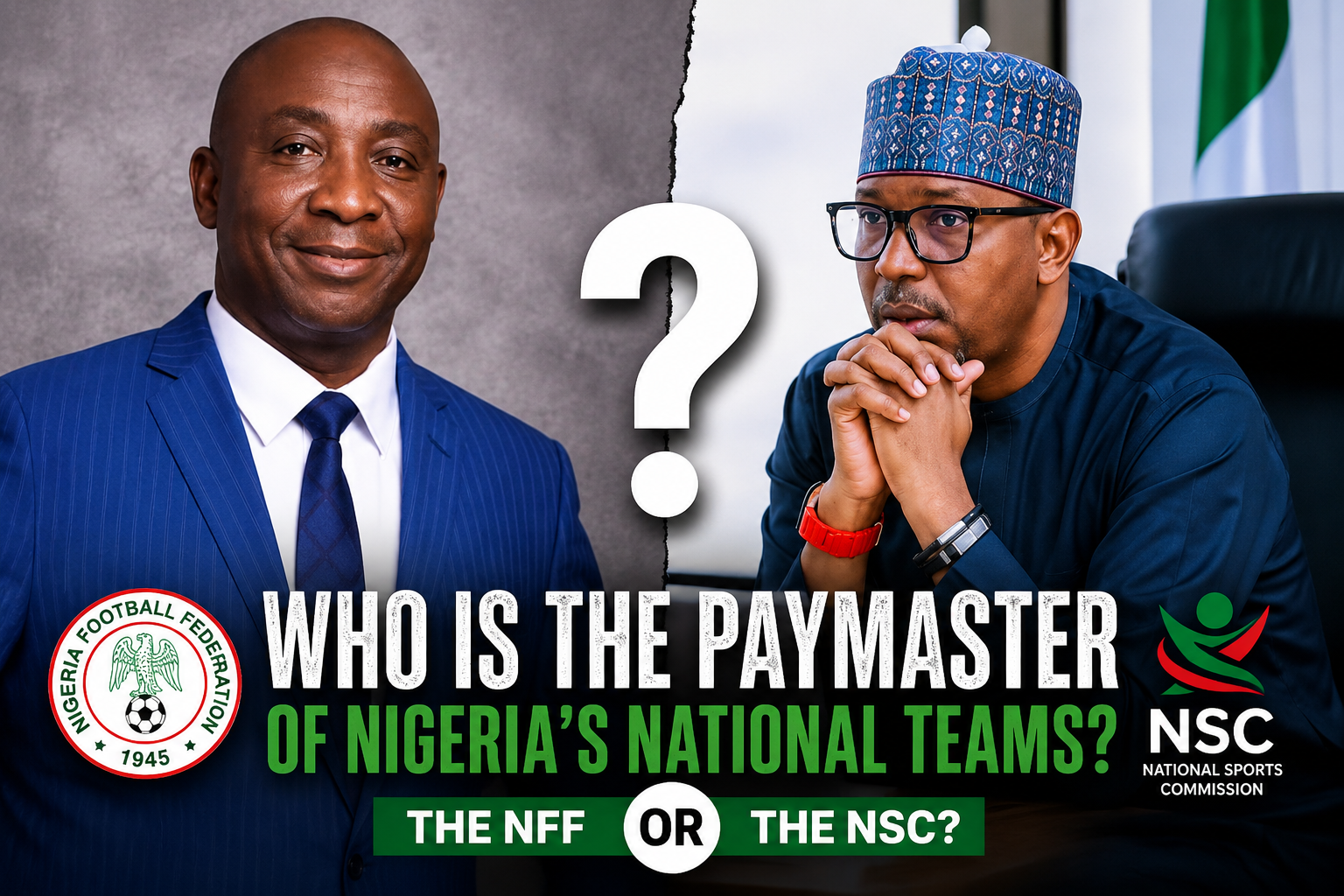
One crucial issue that desperately requires public clarity is a fundamental question: Who actually pays Nigeria’s national teams?
The Misconception of the Paymaster
Many Nigerians operate on the assumption that the NFF is directly responsible for paying players’ bonuses, allowances, and government-approved cash rewards. That assumption is understandable, given the NFF’s visibility, but it is administratively incorrect.
Consider the recent case of the Super Falcons.
Following their triumph at the 2025 Women’s Africa Cup of Nations (WAFCON), President Bola Ahmed Tinubu announced generous rewards: \$100,000 and a three-bedroom apartment under the Federal Government’s Renewed Hope Housing Programme for each player, alongside \$50,000 and matching housing benefits for members of the technical crew.
Yet, as Super Falcons captain Rasheedat Ajibade publicly revealed, those promises remain unfulfilled. Expressing deep disappointment over the delay, she noted that the team would publicly announce whenever the commitments are finally redeemed.
Delays of this nature severely undermine morale. Athletes who give their all to honor their country have every right to expect government commitments to be honored in return, and without friction.
But who should Nigerians hold responsible for these delays?
The Division of Labor: Request vs. Release
From an administrative standpoint, the NFF is not the primary paymaster of Nigeria’s national teams.
Its official duty is to compile and submit the financial requisitions—covering tournament budgets, training camps, logistics, and player entitlements, to the appropriate government body.
Beyond that submission stage, the actual responsibility for securing federal approvals and releasing cash rests with the National Sports Commission (NSC) and the broader financial apparatus of the Federal Government.
To put it simply: The NFF prepares the invoice; the NSC and government financial machinery drive the funding process.
This distinction is vital. Public pressure works only when directed at the institution holding the keys to the specific problem.
Precision, Not Absolution
Distinguishing between these roles is not an attempt to absolve the NFF of its missteps.
The Federation must continue to be held fiercely accountable for football administration, technical planning, youth development, and overall governance of the domestic game. Where technical preparation or administrative foresight fails, the buck stops at the NFF.
However, when the issue centers specifically on delayed government disbursements, unpaid statutory allowances, or unredeemed presidential promises, the conversation must accurately target the National Sports Commission.
Nigeria’s sports ecosystem will only improve when we diagnose systemic failures correctly.
Misplaced outrage solves nothing; informed public engagement forces structural reform.
If we genuinely want our national teams to thrive on the world stage, we must demand accountability from every institution according to its true administrative mandate. Only then can we build a football administration that is transparent, efficient, and worthy of the passion millions of Nigerians invest in the green and white jersey.
Leave a Reply